
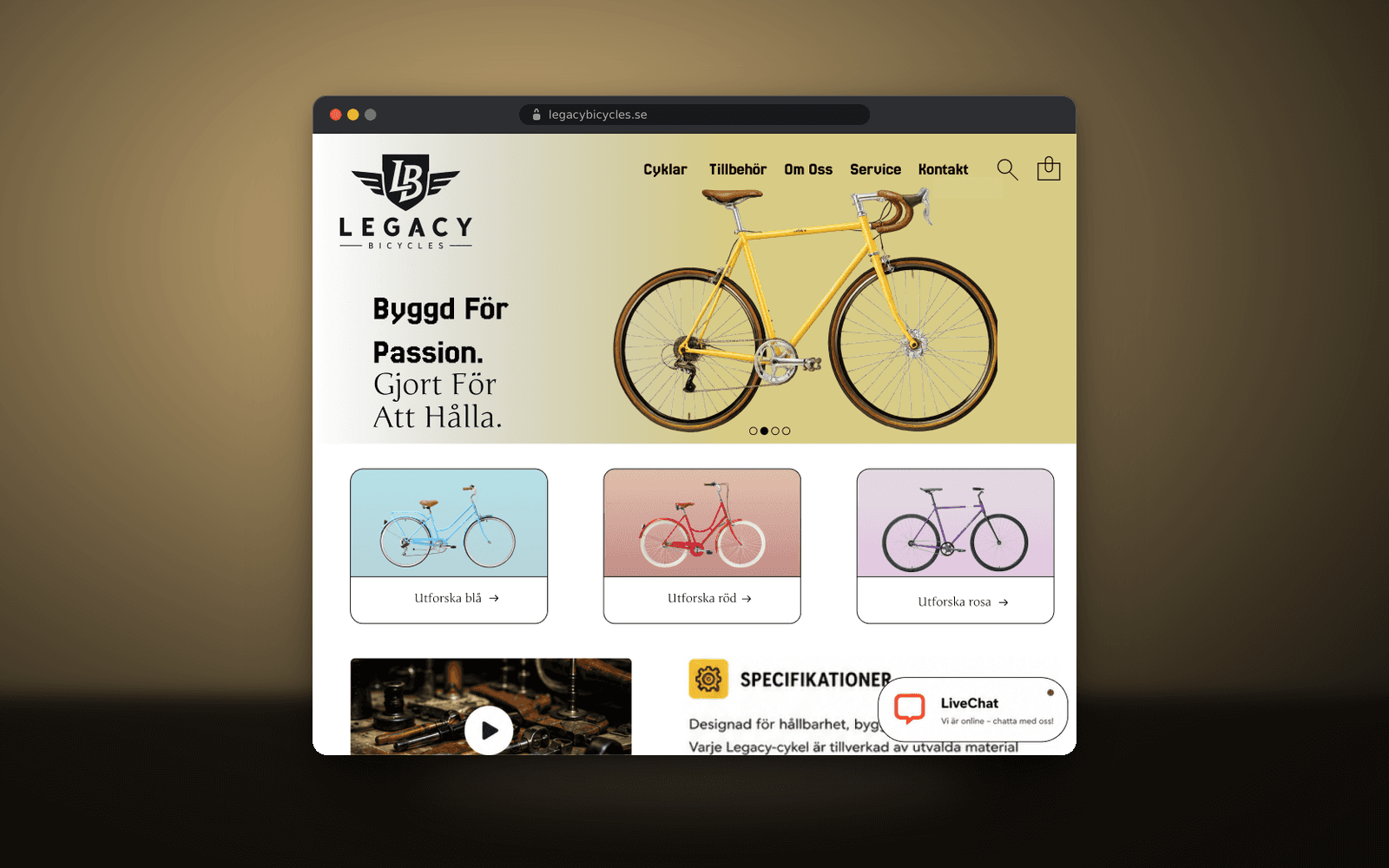
Problem
Legacy Bicycles, Service design
Tools
Miro, Figma
Role
Service Designer, team of five
Timeline
4 weeks
01 - Context
A Craft Business That Only Exists Inside the Shop
Legacy Bicycles is a family owned workshop that has built bikes by hand for generations. Its stated values are tradition, innovation, community and sustainability, and three of the four are genuinely lived.
The brief was to help Legacy reach new audiences, mainly younger ones, without weakening what already works. That pushed the project toward service design rather than a redesign. The question was never whether the bikes were good. It was what happens to a customer in the months before and after buying one.
02 - Problem
Every Strength in the Product, Every Weakness in the Service
A SWOT analysis put the company view of itself next to the market view. The result was unusually clean.
Strengths: high quality, durability, real craft expertise, loyal customers.
Weaknesses: no social media, no online shop, no smart technology in the bikes, no digital touchpoints anywhere in the journey.
Threats: competitors are digitalising faster, the shop is hard to find because the marketing is weak, and the younger generation chooses elsewhere before Legacy is ever considered.
Research also surfaced something outside the brief. There is internal reluctance toward technical innovation, and hierarchical structures that slow decisions. The innovation team can see customers asking for GPS, smart locks and apps, and cannot ship them. That mattered for the design. A strategy requiring the organisation to move quickly would have been the wrong strategy for this organisation.

SWOT analysis
03 - Research and Insights
Three Customers, Mapped Separately
We identified three personas in the research material and kept them apart instead of averaging them into one target customer. Each got their life mapped, then their journey mapped from discovery to post purchase, with touchpoints and an emotion line underneath.
The traditionalist
Wants a product that lasts. Values nostalgia and durability over technology. Main pain point is inconsistent standards between resellers, where service and knowledge vary depending on which door you walk through.
The functional commuter
Has strong technical interest and wants efficiency in everyday life. Main pain points are no e-commerce, no online customisation and no digital support after the purchase.
The intense weekend rider
Focuses on performance in demanding terrain. Wants GPS, digital customisation and proof that the bike performs. Main pain points are no way to see the bike perform before committing, and no community afterwards.
To pressure test the findings we storyboarded one of them. Linus hears about Legacy from a colleague, finds a website that sends him to a reseller, sits in traffic to get there, discovers the bike is not in stock because of a warehouse system problem, drives to a second shop, and finally buys. His first proper ride is then cut short because there is nowhere to find out where he can actually ride.
Key insight
All three journeys have the same shape. Every emotion curve peaks in the middle, inside the shop, and collapses at both ends. Legacy does not have a product problem. It has a before and after problem.
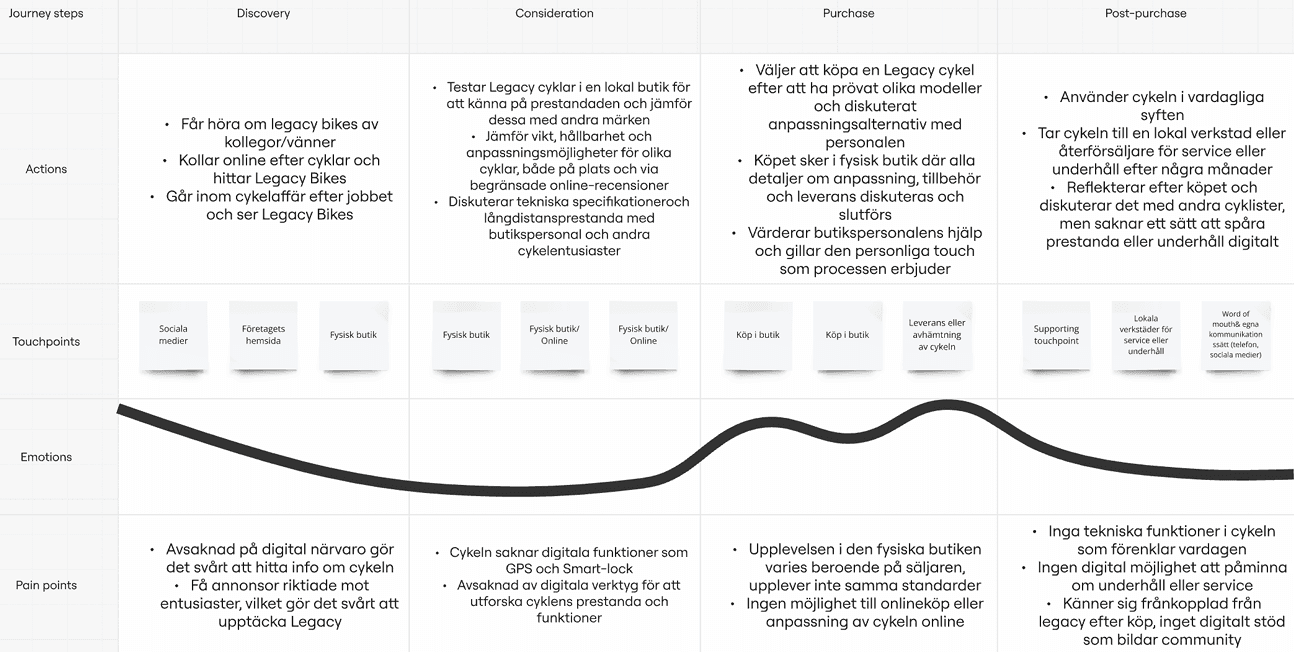
Customer journey map, The Commuter
04 - Process
From Customer Values to a Design Strategy
Four weeks, planned with a Gantt chart and a work breakdown structure, documented in Miro. The sequence mattered more than any individual method. We established what customers value before deciding what to build, so the concepts had something to be judged against.
We mapped the values the service could deliver in four tiers. The top tier is the one that changed the project, because it is the level Legacy already reaches and the level nothing in its current service supports.
Functional: quality, sensory appeal, reduce effort, security, durability.
Emotional: nostalgia, aesthetics, trust, performance, pleasure.
Life changing: connection to the past, self actualisation.
Social impact: self transcendence, community.
Rather than one set of principles for the whole service we wrote one for each phase of the journey, tied to the pain points that phase actually had. Discovery should catch the rider early by showing what makes Legacy distinctive. Consideration should make the decision easier through real information and comparison. Purchase should feel as high quality as the product. Post purchase should build a long term relationship through service and support.

Premium value pyramid
05 - Solution
A Service System, Not a Website
The proposal covers the whole journey and puts most of its weight on the two ends that were collapsing. Two external partners are built into it, because a company that is slow to move on technology can still move quickly on relationships.
Discovery
A partnership with Marcus, an established name in the cycling community, producing genuine content showing Legacy bikes performing in demanding terrain. It closes the digital presence gap without requiring Legacy to become a media company, and it starts the community the weekend rider is looking for.
Consideration
An interactive platform where riders design and adapt their own bike, supported by 3D models, video, full specifications and reviews from other riders. It answers the strongest expressed need in the research, which was to see the bike perform before committing.
Purchase
Flexible payment and delivery, including online invoicing, instalments and delivery to a pickup point or chosen reseller. Live chat and video consultation alongside it, against a standard the sales team follows, so the quality of advice stops depending on which shop you happen to enter.
Post purchase
An automated service system that sends reminders based on the usage pattern captured at purchase, self service maintenance information, a forum, and physical community events. Plus a partnership with Maya Rodriguez and West Coast Green Tomorrow, planting a tree with every bike sold.

Instagram mockup

Configurator, design your own bike

Customer service, FAQ and live chat
06 - Impact
The Same Journey With the Ends Filled In
The future state blueprint is the current state one redrawn. It is the clearest way to show what the strategy does. The emotion line stops collapsing in the two places it was collapsing, and it does so without touching the middle, where the company was already strong.
Community
Digital and physical places for enthusiasts to meet each other, the company and both external partners, with all four getting something out of it.
Sustainability
An existing core value made visible and provable through the partnership, rather than only claimed.
Personal
Configuring your own bike answers the loudest need in the research and turns a transaction into something the customer had a hand in.
Traced through the future state storyboard, the same person now discovers Legacy through a rider he already follows, configures a bike on the site, orders it to his own address, finds a route through the forum, and turns up weeks later at a Legacy community event where he recognises people from that forum.

Future state journey map and service blueprint

Ecosystem diagram
07 - Reflection
What This Would Cost and What I Would Challenge
An automated service system and an interactive platform are two significant investments for a family business. We said so in the report instead of leaving it for someone else to discover. If I ran this again I would sequence it. The influencer partnership and the community events need almost no technology and would fund the argument for the platform.
Prioritising the intense weekend rider also risks losing the commuter and the traditionalist. We flagged it as a risk, but flagging is not solving. How much of the service can be shared across all three is the first question I would take into a second round.
Step four of our own design strategy was user testing and feedback. We validated against the research material and the client, but never put the concepts in front of the three personas. That is the honest gap in this project, and the reason I now treat who tests this, and when, as a scoping question rather than a final phase.